

Embodied AI makes quantum leap in China
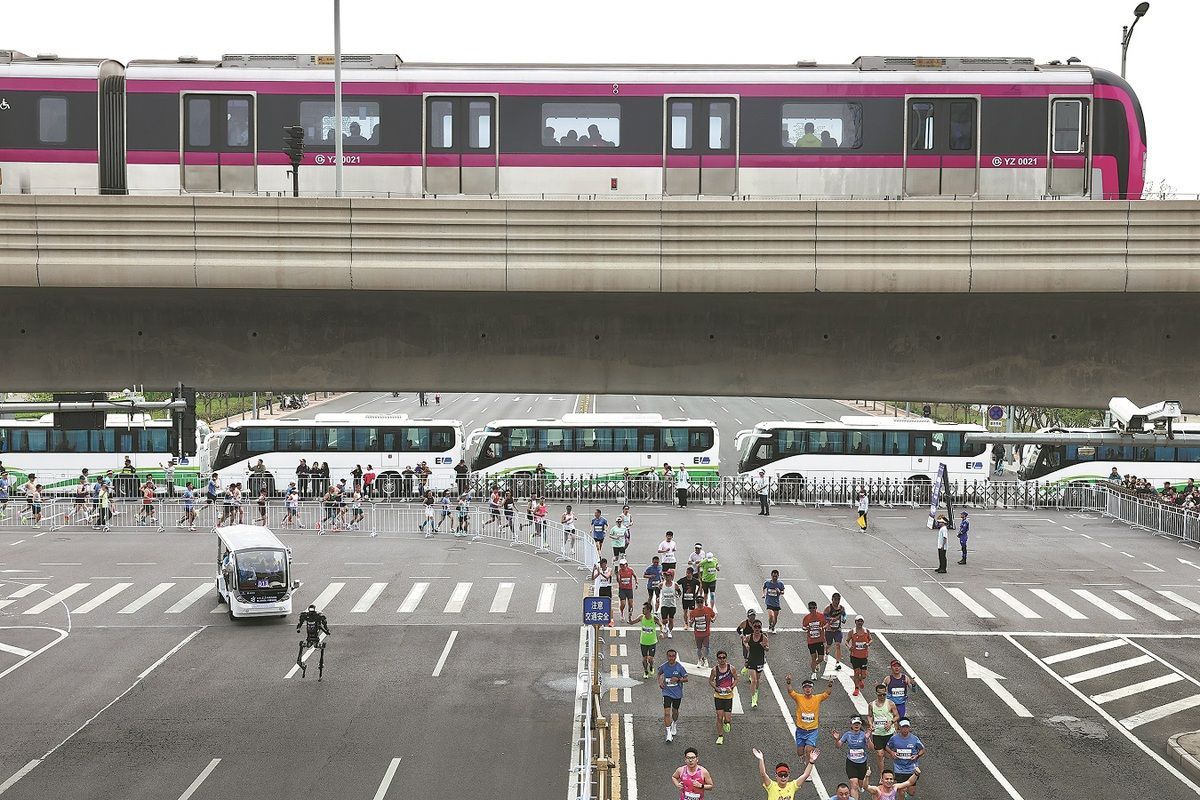
A humanoid robot together with human participants runs during the 2026 Beijing E-Town half marathon and 金华工会新闻网首页humanoid robot half marathon in Beijing on April 19. WEI XIAOHAO/CHINA DAILY
At around the 18-kilometer mark of the Beijing E-Town half marathon and humanoid robot half marathon, where the course narrows and the incline begins to bite, a humanoid robot broke its rhythm and did something unexpected. It accelerated.
Spectators along the roadside, many of them more accustomed to watching human runners grind through fatigue, leaned forward as the humanoid machine lengthened its stride and powered ahead.
Moments later, a humanoid robot named Lightning crossed the finish line in 50 minutes and 26 seconds, faster than the human world record holder, Uganda's Jacob Kiplimo, who finished the same distance in about 57 minutes at a road race in Lisbon in March.
But the real story was not the winner. It was a proving ground, a stress test, and a public demonstration of how far embodied artificial intelligence has come in China.
In a global context increasingly defined by technological rivalry, it offered a vivid snapshot of how China is positioning itself in competition with the United States in a race no longer confined to chips and algorithms, but one that extends into smart machines that move, perceive, and act in the real world.
At first glance, the spectacle carried a certain novelty. Dozens of humanoid robots, some with humanlike gaits and others still stiff and mechanical, lined up alongside support vehicles and engineers monitoring telemetry feeds. But beneath the theatrics lay a deeper shift.
A year earlier, in the inaugural event, nearly all robots required constant remote control. Engineers jogged alongside them, adjusting balance, correcting direction, and sometimes physically intervening to prevent falls. Only a handful of teams finished the course.
This year, the story has changed dramatically. More than 100 teams entered, a fivefold increase. Nearly 40 percent of the robots navigated autonomously, interpreting the course, adjusting stride, and managing energy consumption without direct human control. Operators followed in vehicles rather than running beside them.
Yan Weixin, chief scientist at the Shanghai Artificial Intelligence Research Institute and a professor at Shanghai Jiao Tong University, said the sharp improvement in robot half marathon performance is, at its core, a combined validation of hardware reliability, algorithmic stability, and system engineering capability. "It was not a breakthrough in any single technology, but the coordinated evolution of all of them."
The course of the marathon was deliberately unforgiving, combining flat stretches with inclines of up to 8 percent, descents, tight turns, narrow lanes, and even obstacles designed to mimic real urban disruptions.
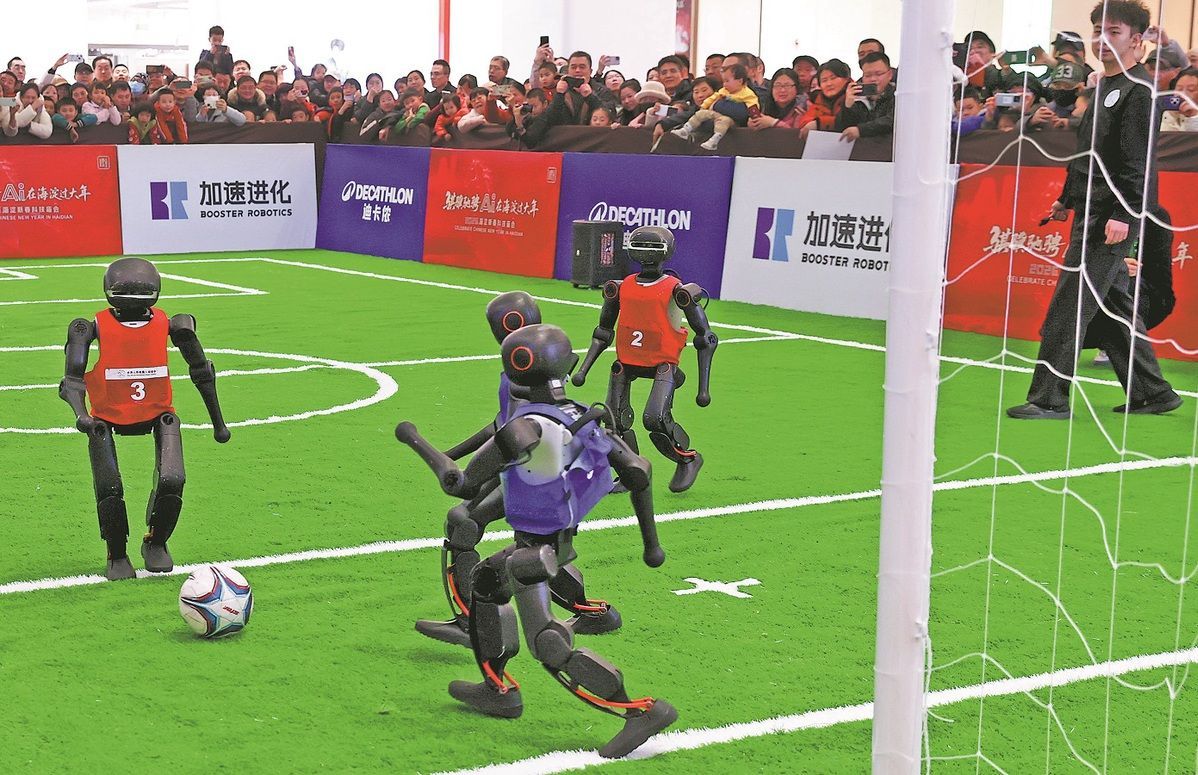
Audiences watch a robot football match during a Chinese New Year fair in Haidian district in Beijing on Feb 19. CHEN XIAOGEN/FOR CHINA DAILY
Over more than 20 kilometers, robots had to maintain balance, regulate joint temperatures, optimize battery usage, and adapt to changing terrain. In engineering terms, it was an endurance test across multiple failure modes.
Apart from Lightning, a group of other robots also completed the course in under an hour, a dramatic leap from last year's win time of more than two and a half hours.
In fact, humanoid robots have caught wide attention from both the public and investors in recent years. This year's Spring Festival Gala saw an amazing performance from several humanoid robots, while the Zhongguancun Forum in March demonstrated the latest technology concerning embodied intelligence.
Yan said: "The Spring Festival Gala demonstrated that robots could be controlled and visually impressive. The half marathon, by contrast, proved their reliability and endurance."
He said that on a stage, repeated rehearsals can deliver a one-off flawless performance. But in real-world conditions, where unexpected variables are constant, it is a completely different challenge.
"Completing a half marathon means robots now possess the baseline capability to enter industrial environments," he added.
As Chinese robots begin to compete at scale in extreme tests like the half marathon and deliver strong results, they are effectively setting new industry benchmarks, he emphasized.
Noting that this year's event drew teams from Germany, France, Portugal, and Brazil, which signals growing international engagement, Yan said that China is no longer a follower in humanoid robots, but is beginning to influence how the game rule is set.
According to the 2025 humanoid robot market research report released by CCID Media, a division of the China Center for Information Industry Development, China had more than 140 humanoid robot manufacturers in 2025, with total shipments reaching 14,400 units, accounting for 84.7 percent of the global market.
US companies including Tesla, Boston Dynamics, and a wave of startups are developing humanoid systems, often emphasizing general purpose capabilities. Tesla's Optimus project, for instance, aims to deploy robots in factories as a first step toward broader use. Boston Dynamics continues to refine mobility and dexterity, albeit with a focus that has not yet fully shifted to humanoid form.
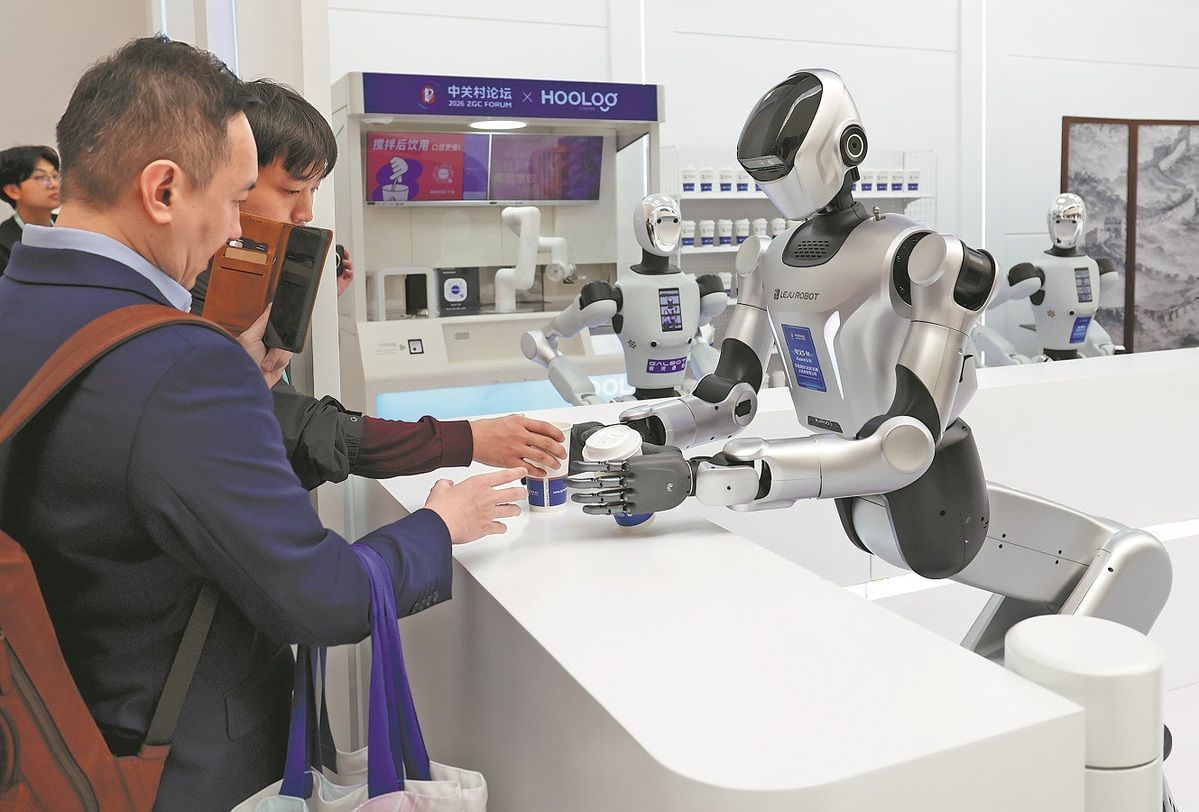
A humanoid robot serves beverage to visitors during the 2026 ZGC Forum Annual Conference in Beijing on March 25. ZOU HONG/CHINA DAILY
China's approach, by contrast, has been more ecosystem driven. China has explicitly identified embodied intelligence as a strategic emerging industry. The inclusion of the field in national development plans has been accompanied by standards setting, funding support, and pilot programs across sectors.
"Policy alignment matters," said Liang Liang, deputy secretary-general of the Chinese Institute of Electronics. "It ensures that technological development is linked to application scenarios. The marathon is a good example. It creates a real-world test environment that pushes companies to solve practical problems."
Wang Peng, a researcher at the Beijing Academy of Social Sciences, said: "Chinese companies excel at engineering optimization built on open-source technologies. This has made it possible for robots to dynamically adjust gait and manage energy consumption in demanding scenarios like a half marathon."
"This combination of government guidance and market leadership has compressed the cycle from research paper to commercial product to just a few months. China's core competitiveness is not a single technological edge, but the ability to build integrated systems. That will drive humanoid robots into more complex and commercially viable applications," he said.
The transition from demonstration to deployment is already underway, though unevenly. China's domestically developed H1 humanoid robot from Unitree Robotics has reached a straight-line running speed of 10 meters per second.
Meanwhile, Leju Robotics, in partnership with Dongfang Precision, has launched an automated production line in Guangdong with an annual capacity in the tens of thousands of humanoid robots.
UBTech Robotics has also entered into a strategic partnership with Honda to accelerate deployment in industrial manufacturing and warehouse logistics scenarios.
Perhaps the most emblematic is the emergence of large-scale manufacturing facilities dedicated to humanoid robots. In Beijing's E-Town, a new "embodied intelligence super factory" has begun initial deliveries. The facility integrates component production, joint module assembly, full system integration, testing, and logistics into a single, highly automated pipeline.
Designed for flexibility, the factory can switch between robot models in under 15 minutes, while maintaining full data traceability across the production process. It is capable of continuous operation, with autonomous logistics systems and parallel testing environments.
The operator behind the facility, Lingyi iTech, plans to reach annual output of 10,000 units by 2026 and scale to 500,000 by 2030. The company has already secured orders from international clients, including North American firms, signaling early global demand.
Ding Han, an academician at the Chinese Academy of Sciences, described humanoid robots as a potentially transformative technology, comparable to computers or smartphones, but emphasized the distance still to be traveled.
"Human robot integration is the future of manufacturing. But humanoid robots are not yet ready for widespread application. There are still many scientific and engineering challenges to overcome," he said.
Ding said these include energy efficiency, cost reduction, safety, and the development of standardized platforms that can support diverse applications, and that most deployments remain limited in scope.
- ·金曲最佳新人暨最佳制作人孔令奇与大马名媛陈铭君于吉隆坡举办盛大中式婚礼
- ·没有感觉到烫 却被烫伤了 这是为啥?一图了解→
- ·春运来了,如何稳稳到家?
- ·大悟吕王:农文旅融合兴产业 乡村蝶变惠乡亲
- ·安庆宿松县招商引资新突破积蓄发展新动能
- ·大学生雪地里摔晕后,3根手指或面临截肢
- ·戏润童心 总台首届少儿戏曲大会今日收官!
- ·戏润童心 总台首届少儿戏曲大会今日收官!
- ·安徽“强链补链”计划助推制造业集群发展
- ·锚定数智经济一线城市,武汉有底气
- ·20年243次,他当选中国好人!
- ·经济热点快评|各地公布GDP,透过数据我们看到什么?
- ·国开行去年发放基础设施贷款1.53万亿元
- ·Unlocking Chinese Cities: A city living with the wetlands
- ·跟着全镇唯一的“跑腿”,走进村里老人的家丨相对论·新春走基层
- ·新春走基层丨武汉三座火车站绘出春运“立体拼图”